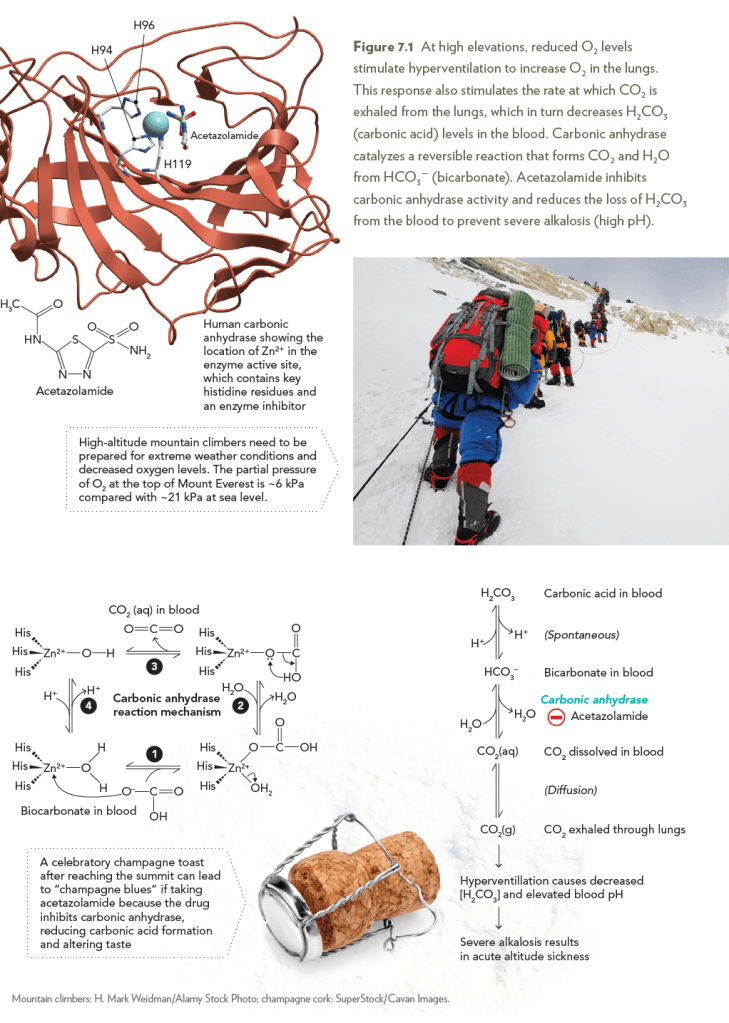
Altitude-induced alkalosis can occur at elevations above ∼15,000 feet if
supplemental oxygen is unavailable. The cause of altitude-induced alkalosis
is hyperventilation to increase O2 levels in the lungs, which, at the same
time, increases the rate at which CO2 is exhaled. As a result of hyperventilation,
CO2(aq) levels in the blood are reduced, and, by Le Châtelier’s
principle, carbonic acid (H2CO3) levels are also reduced, which increases
blood pH levels (alkalosis). Because H2CO3 is spontaneously deprotonated
to form bicarbonate (HCO3–), which is a substrate for the enzyme
carbonic anhydrase, inhibition of carbonic anhydrase activity by the drug
acetazolamide decreases the rate at which H2CO3 is removed from the
blood. Carbonic anhydrase is a Zn2+-dependent metalloenzyme that has
a critical role in maintaining blood pH by catalyzing a reversible reaction
that controls the levels of HCO3– and CO2(aq) in the blood.
Study guide: Chapter 7 — Enzyme Mechanisms

