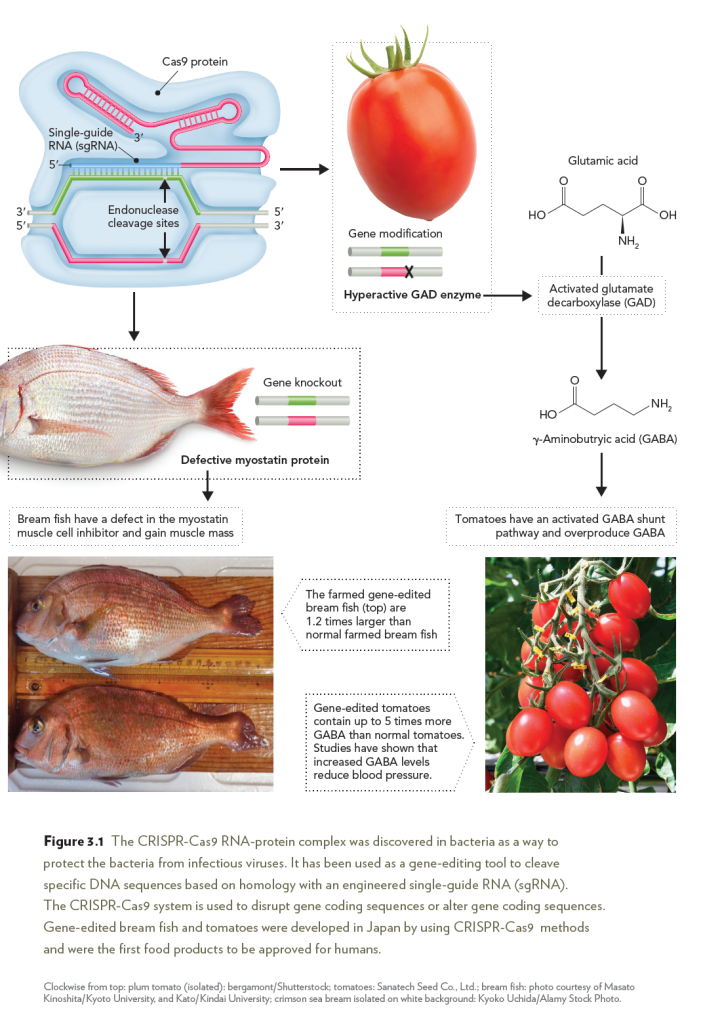
The bacterial CRISPR-Cas9 gene-editing process has been successfully
applied to commercial food production, specifically in fish farming and
agriculture. Many of these advances have been developed in Japan, where
private companies have used this gene-editing technology to enhance
the quality and quantity of food products. The two examples illustrated
here alter regulatory mechanisms leading to greater muscle content in
bream fish and elevated levels of γ-aminobutyric acid in tomatoes. The
CRISPR-Cas9 gene-editing process was used to disrupt functions of
the myostatin gene in bream fish, as well as to modify the function of the
GAD enzyme in Rouge tomatoes. Because no foreign DNA was introduced
into the farmed fish or the tomatoes, these food products are not
labeled as genetically modified organisms.
Study guide: Chapter 3 — Nucleic Acid Structure

