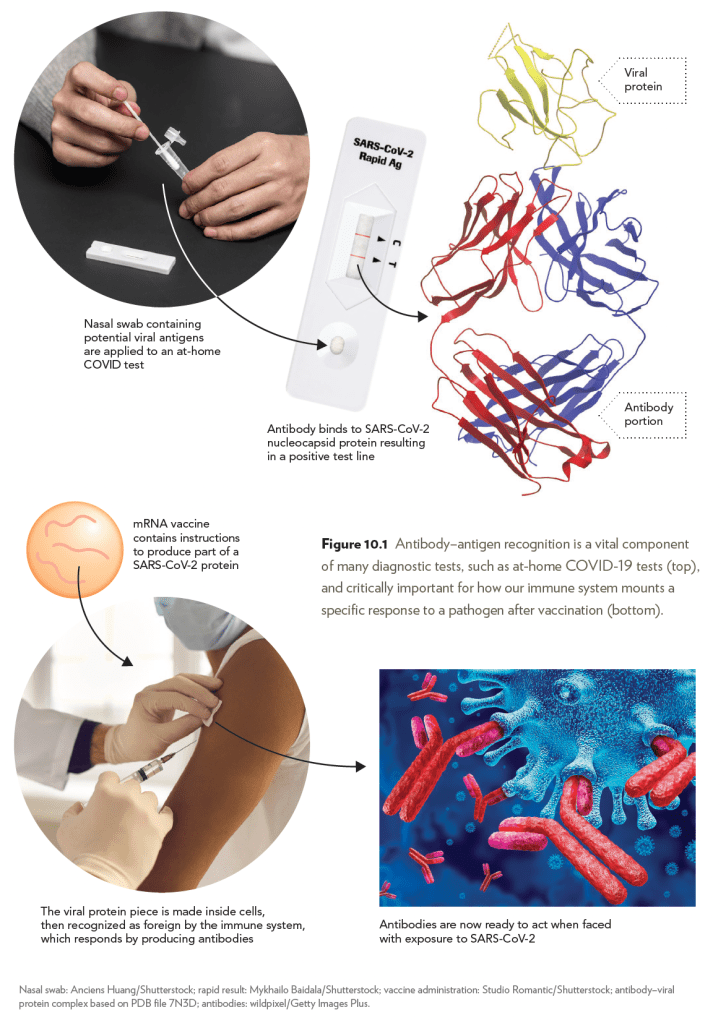
At-home COVID-19 testing kits use the principle of antibody–antigen recognition to detect viral particles in a liquid sample from a nasal swab. When the antibody binds
to a viral antigen and then is bound by another antibody that provides a
visual readout, the presence of viral particles can be determined. These
rapid-response tests make it possible to quickly determine whether an
individual likely has an active infection, even if no symptoms are present.
mRNA vaccines were used extensively during the COVID-19 pandemic.
These vaccines contain genomic material that encodes part of a viral protein,
so that when the mRNA is inside cells, our ribosomes will produce
this protein segment. By itself this viral protein is incapable of causing an
infection, but it primes the immune system to produce antibodies to recognize
this protein if the immune system is subjected to it in the future,
such as after exposure to the virus.
Study guide: Chapter 10 — Antibody Proteins

